

-
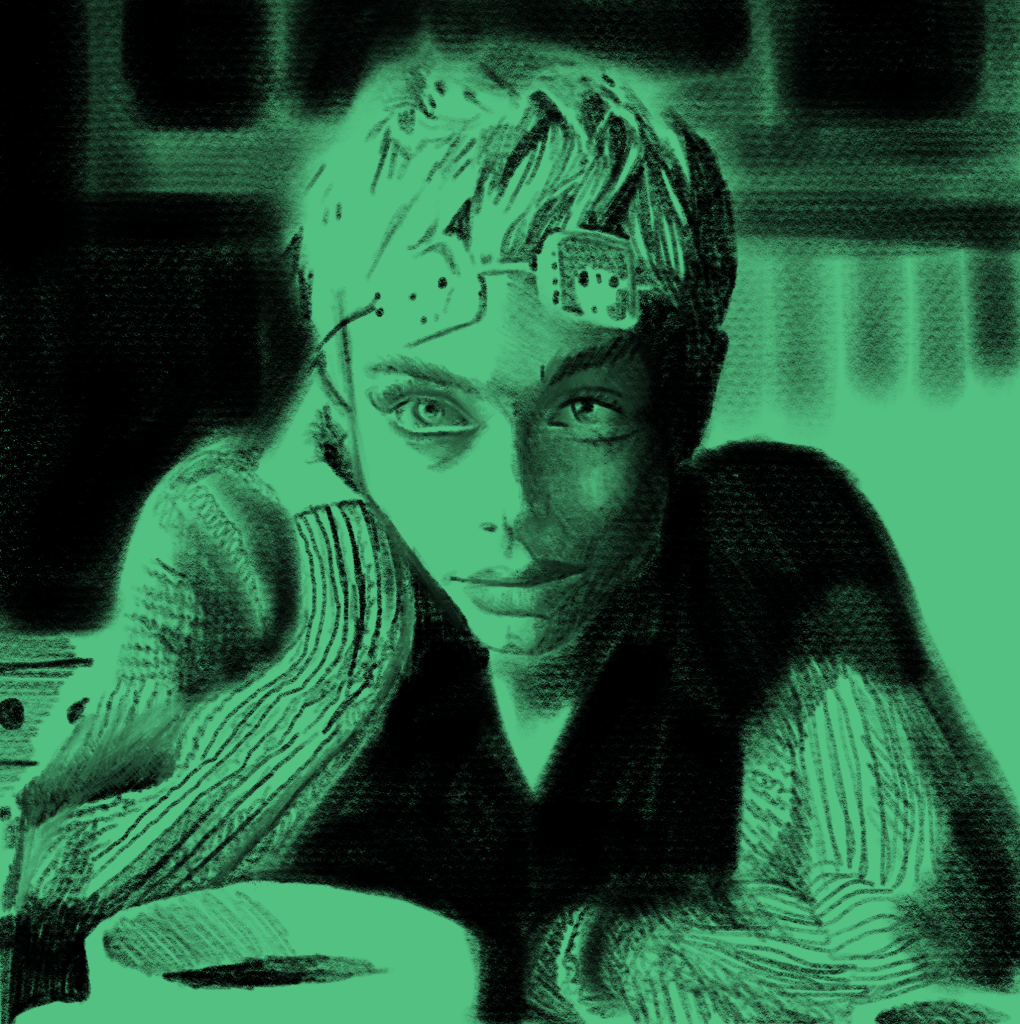
When I asked her out to coffee and she said ‘yes,’ I scarcely believed it. It was fluke and happenstance that brought me into her presence in the first place and, insignificant as I am, it seemed impossible that I could do otherwise but slide out of it without making a sound. She was – she is – well. We all know. Significant is putting it mildly, in my opinion. She towers above us even now, at the low ebb of her celebrity. When I approached her, I felt like the narrator of “A New Age,” although my words were more halting and delivered with no conscious exercise of metre. “I’ve seen every movie you’ve been in, from Paths of Pain to Jewels of Glory…” Although, of course, she never starred in films. The point is I asked her out to coffee and she said ‘yes.’ She took a drag from her cigarette, looked me up and down and then skewered me with the needles of her eyes. She said ‘yes’ and she exhaled so that the word was visible. It curled into the red gloaming, reared up like a cobra and drifted upward towards the few remaining stars. Thereafter, we made arrangements.
My usual haunts, I knew, were wholly inadequate for the occasion. In truth I get out so rarely these days that my only “usual haunts” are a supermarket two blocks away from my apartment, a sandwich shop on the corner of my subway stop, and a little bookstore to which I sometimes walk on weekend afternoons along the parkway. To discover a suitable venue, I had to peel back the onion of my memory, enduring the astringent sting of youthful springs now past and gone.
I determined to ask her (since she is famous as many things but most of all as a New Yorker) whether she had ever observed a strange phenomenon that I myself took note of in the first year after I moved to the city. I called it then and call it now (for want of better nomenclature) the “New York honeymoon.” The honeymoon is a period where the city itself, that strange and populous amoeba, that human anthill, seems to open wide its gate and show itself to best advantage. It is, no doubt, partially a function of perspective: to the newcomer the occasional delights of New York are painted in more vibrant hues than its everyday horrors. Subjectivity, however, cannot wholly explain the experience of my honeymoon.
In those days people would hold the subway doors for me with a smile and shopkeepers would give me discounts (for sometimes as much as twenty dollars) just “because.” No matter where I, or the young women I was courting, stopped for dinner we were always given free dessert by waiters who doted on us like actors making the most of a bit part. All was grace and interest and even the winters were mild, as I recall. Although my honeymoon in New York City did not last long it lasted long enough for me to find Milk and Chocolate and it was to Milk & Chocolate that I asked her for coffee.
How shall I explain it? Milk and Chocolate is a cafe. It has been open now for about a quarter century. It is just north of Williamsburg, near the bridge to Long Island City, and although it sits on a corner lot of a pricey district its prices are eminently reasonable. It has a big wooden bar, polished and lacquered, the kind of bar that makes it look like a model room from the 1880s preserved for historical purposes as the Metropolitan Museum of Art. It has a backyard: a wide garden, green all year round and strung with amber lights sprouting from vines of dark wires. The chairs are comfortable and the baristas operate the chrome edifice of their antique espresso machine with practiced grace. There is nothing of the put-on about the place, nothing of artifice, although I suspect that admitting its proximity to Williamsburg will cause people to doubt the assertion of sincerity. Since I am not eloquent, I have no choice. I must simply ask you to believe me. Milk And Chocolate is, in every detail of its operation and decor, a rare oasis of grace. It is the antithesis of everywhere.
That explanation is unbelievable enough. Sadly, I must beg a further extension of your credulity. The grace of Milk and Chocolate is the beginning of the place but not the end. There is something else within it: an invisible radiance, a still vibration. A feeling. For this feeling there is no English word. I have said that Milk and Chocolate is the antithesis of everywhere – and it is. But “antithesis” is a soft word and it is softened further, I suspect, by the sweet, organic, comfortable and creamy associations conjured by the name of the place. Milk and Chocolate is soft, in a way, but softness is not the end of it. It is a cloak of velvet with a knife inside.
It shivers with disgust for the century beyond its doors. It despises sunshine, even at noon. The books on its walls are old and meticulously organized. It is, to my knowledge, the only cafe in the continental United States with its own card catalogue and Dewey Decimal filing system. Personal electronics do not work there. Even leaning in the door to ask directions will transform a thousand-dollar phone into an irreparable paperweight – even if said phone is carried in a shoulder bag which, at no point, passes the threshold onto the premises. The workers behind the counter find the distress which follows from such incidents of sabotage delightful. Nothing seems to please them more. They laugh like hyenas.
Milk and Chocolate is also, as far as I know, the only eatery in Brooklyn where indoor smoking is not only permitted but compulsory.
It is, in sum, a difficult place to be. Why not? Grace is difficult to achieve and near-impossible to maintain. It must be remembered that every space of peace and dignity which flowered in the dark soil of departed century us could only do so because it was fertilized with the sweat of human bondage. How much simpler a supermarket is! Beneath those buzzing tubes of halogen, we are permitted no secrets and consequently bear no shame. So goes the world – and so, in opposition, goes Milk and Chocolate.
I am doing a poor job of conveying my meaning. I must employ an anecdote.
Long ago, while I was in my honeymoon, I found myself caught in a sudden downpour. I was riding a bicycle through Green Point, heading for a particular shop which sold specialty hobby supplies. It was then that I first saw Milk and Chocolate. Since the promise of hot coffee was preferable to the wet and cold of the street outside, I arced onto the sidewalk and locked my vehicle to a public stand. I ducked into the café (its interior was as I have described it) and took a seat at the bar. The woman who was working suggested I hang my dripping coat on the rack beside the door. I did so. I also ordered an espresso. Although I had arrived in the dead of the afternoon and on a day of frightful weather, there were a few other patrons lounging at the interior tables. A few were alone, reading or writing. By the window a couple was arguing in whispers. Their difficulties seemed existential.
My coffee arrived steaming. The woman behind the counter laid down the cup and then laid a saucer down beside it. On the saucer was a square of chocolate in a golden wrapper, a small carafe of milk and a large iron-gray pill.
“What is this?” I asked. That I had been given more than I had ordered was not surprising, for reasons I have said. What was surprising was the nature of the gratuity. I had never been given a free pill before – not even at the pharmacy. Then (as now) I had no health insurance.
“What is this?” I asked.
“Dianazene,” said the barista, as it that explained everything.
“And what is Dianazene?”
“Not much. Vitamins and nicotinic acid. It can cure skin cancer and sunburns.”
“Really?”
“Of course not. But that’s what he said about it.”
“He?”
“Ronald Lafayette Hubbard.”
The name was familiar to me but I couldn’t quite place it. “Who?”
“Have you ever heard of the Church of Scientology?”
“Oh, yes. Now I recognize the name. He was their founder… their messiah. Are you a…?”
“Oh no. Of course not. And Hubbard wasn’t just a messiah. He was a photographer and jazz musician and a nuclear physicist.”
“Really?”
“Of course not. But that’s how he described himself.”
“And he said Dianazene could cure sunburns?”
“Yes. This was in the late 1950s, after the Soviets got the H-Bomb. Everyone was worried about being obliterated. They had radiation poisoning on the brain. Hubbard said that ‘radiation was more a mental problem’ than a physical one. He thought the big problem wasn’t the bomb. It was fear of the bomb. He sold Dianazene because he thought it would make people feel safe. Because if they felt safe, they would be safe. And he could make money. He named it after his daughter, Diana. Hence Dianazene.”
I looked at the pill. It seemed suddenly heavier. “And it didn’t work?”
“Not even remotely. The FDA banned it for being snake oil.”
“How did you get it, then?”
“Oh, we make our own. Small batch, artisanal Dianazene. We’re not the only place in the city that does it but I like to think we do it best.”
“But why do you do it?”
There was cryptical tremor in her epicanthal folds. “Because we’re called Milk and Chocolate.”
“What does that have to do with anything?”
“It was Hubbard’s recommended method for the ingestion of Dianazene. ‘To be taken daily, with milk and chocolate.’”
“How odd,” I said, considering the strange artifact on the saucer before me.
“Not odd at all,” she said. “What are you supposed to do when the power of God is in the hands of bureaucrats? When the only thing standing between you and instant, atomic and subatomic disintegration is a skein of paperwork?”
I did not know what to say to that. Content aside, I was not used to people speaking to me in complete sentences. At last, I answered her as if she’d told a joke. “I don’t know,” I said. “What do you do?”
“You have dessert,” she said, before turning around to serve a newly arrived customer. I added milk to my coffee, placed the chocolate on my tongue and swallowed my Dianazene.
That is the nature of the place and it was for that reason that I judged it worthy of her. When I asked her out for coffee and she said ‘yes,’ I had only one destination in mind. We agreed to meet and Milk and Chocolate two days later, at eight o’clock.
In the intervening days I tried to convince myself that I was not worried: that my anxiety, after years of running rampant, had finally been tamed by good habits and clean living. I will not overthink things, I told myself. I’ll take my circumstances as they come and be present – present! – for every bit of it. I won’t let my mind wander or my thoughts stray. It didn’t matter that she was clearly someone while I was just as clearly no one at all. It didn’t matter that she was thirty years my senior, or that her eyes had all the seeming of a demon that is dreaming (she looked like the Nemesis of Neglect in eyeshadow) or that I’d been using a picture of her as the lock screen of my telephone since my freshman year in college. I was ready. I was calm. (These assurances being the surest proof of panic.)
I ran over the potential avenues of our conversation a thousand times while telling myself I wasn’t giving them any thought at all. There were clear pitfalls. It would be no good to try and impress her. One day of her biography easily exceeded any year of mine. Nor could I afford to be trivial. In addition to the achievements that formed the basis of her fame, she was a notorious intellect. She spoke seven languages – six more than I did. Unlike L. Ron Hubbard she actually did have a degree in nuclear physics: it was a scholarship from M.I.T. that first brought her to the United States from the small once-German town where she originated. I like to flatter myself with the idea that I am not exactly stupid (I do have a doctorate in anthropology) but next to her… Well, I felt a great desire to put my best foot forward.
Our age-gap, of course, was strictly verboten. Nothing is more tiresome that discussing the micro-fluctuations of media technology which shade every postmodern decade in a different hue. Sometimes with all the griding difficulty between the “generations” these days it can seem like the past – even the recent past – isn’t just a foreign country but a belligerent one. I dared not begin our evening with a border skirmish.
How can a man with few accomplishments hope to fascinate the phantom of the twentieth century? I wrestled with this problem secretly, far beneath the surface of my conscious thoughts, because I knew it to be an irresolvable problem. In the end, I would do what I would do and, in retrospect, I would find that I could not have done otherwise because I did not do otherwise.
After a tense period of anticipation, the night arrived. I reached Milk and Chocolate at sundown and secured a table by the front window. I dissolved the chocolate in my coffee and swallowed my Dianazene. The light upon the Brooklyn street was bright Vermillion. I saw her shadow as she crossed the street. She wore black, of course. She could not have done otherwise.
We exchanged salutations. She lit a cigarette (I was in the process of quitting). Those eyes! Those terrible eyes! Her order coffee came and she thanked the waiter. “How considerate,” she said, her accent evoking the nocturnal undulations of the hoot-owl. “I do have a mild sunburn.” Without touching her chocolate or taking a swig of her coffee, she swallowed the Dianazene.
“Well?” she asked.
“Right,” I began, clearing my throat. “I suppose I should admit at the outset that there is a barrier between us which is, frankly, impossible to cross. I know a great deal about you. I know you through your work and through the secondary literature that you have inspired and while I have no doubt that my conceptions bear little resemblance to your truest and most complete existence, that fact remains that there exists between us a vast informational gulf.
“What then shall I do? Monopolize the conversation? Disgorge every bit of history and my sense-impressions and the tortured secrets of my psychology in hopes of leveling the playing field? No; not only would such behavior be exceedingly rude – it would also be functionally impossible.
“Although you look at me and see that I possess the requisite biology of manhood: eyelids, shoulder blades, elbows, knees, an Adam’s Apple that bounces up and down like a yo-yo – yes, it is quite humorous – the truth is that I am a man (by which I mean a human being) in only the most superficial sense.
“I know enough of you to know that you are an active agent in the world. You are, whether you want to be or not, a subject of history. You have made pronouncements. Your achievements have been etched in stone. You were born in wartime and lived equally among the sacred and the profane, learning priestcraft and profanity in turn.
“I am not a subject of history. I was born after history had stalled; in the featureless expanse that followed the fall of communism. American consumerism (which, I believe, is largely distinct from capitalism as it is understood in an academic sense) gripped the world unopposed when I was young and it was in the decadent spirit of victory that I was raised.
“I am a rule follower. An uncreative type. My rebellions are consumer rebellions: I have bought the “wrong” clothes, downloaded the “wrong” music. I was raised on the nerdy end of this spectrum. In childhood I memorized the biographies of comic book heroes and the complex chronologies of overlapping brand-universes. My toys were information toys: they encouraged me to absorb and categorize vast quantities of data. Such amusements prepared me for an actuary’s career. The expectation was that my life would be spent not in the achievement of grand ambitions or the pursuit of glittering ideals but rather in the cataloguing and maintenance of the necessary variables to maintain a social and economic system which had already been perfected.
“I don’t need to tell you the nature of the rug-pull that followed; how America’s contradictions hastened it towards collapse just as it had happened to the Soviets. It only took a little longer and was driven by wealth rather than poverty. By the time that I was grown there were no jobs for me to do and I had no skills with which to do them. I am the waste product of a factory that has long been closed.
“What, then, do I do with my time? I consume information. I collect and catalogue trivia and “memes” and songs and movies and Japanese comic books. There is no purpose in this behavior. It is simply all I know how to do.
“Consumerism is a cult of desire. Specifically, it is a cult that studies desire closely and subdivides it into hundreds – thousands! – of specific varieties. Your sexual exploits are legendary. My sexual exploits are non-existent. Sex, to me, is just another biological desire which has been effectively neutralized by the technology of consumption. The nature of my wants have been analyzed and exploited both invisibly and completely. I pay a woman in California to pantomime penile surgery on webcam and am fulfilled. She gets paid, I get off and neither of us even talks to the other. The fulfillment of this desire, like the fulfillment of all others, is a purely economic exchange.
“This conception seems to imply that my desires are the driver of the society in which I live, that consumerism exists to cater to consumers. This, certainly, is its outward claim. America is an implicitly Christian empire. It claims to be meek and servile, powerless to do anything but satisfy its multitudes.
“The situation calls to mind the conclusion of Venus In Furs (a book with which you are, of course, intimately familiar). Severin, quoting Goethe, concludes the account of his sadomasochistic affair by asserting that one must either be “hammer or nail.” Previously the nail he resolves to ever-after be the hammer. This, however, is a fictional conceit as hypocritical as Poe’s assertion, at the end of The Premature Burial that he had mastered his fear of live entombment. After Venus in Furs was published its author, Leopold Von Sacher-Masoch, received a message by post from an appreciative reader. It was a woman. She offered to be his mistress: the hammer to his willing nail. Masoch accepted.
“As an aside, I must admit that my introduction to sadomasochism was neither literary nor musical. Advances in communication technology have provided, as I earlier implied, great assistance to my masturbation. By the time I was elven I had put my internal database to work cataloguing and cross-refencing Japanese erotic comic books which served every possible permutation of my burgeoning desire for orgasmic release. It was during this period that I came upon a series called Bondage Fairies Extreme.
“Bondage Fairies Extreme was a follow-up to the series Bondage Fairies, which concerned itself with the sexual adventures of two scantily clad forest fairies, all of which had a heavily element of dominance, submission and control. Extreme continued this theme but altered the species of its participants. The original Bondage Fairies was a mostly sapphic affair: a young and innocent fairy was dominated by an older and more experience one. By the conclusion of the story, as in Venus in Furs, the roles were reversed. Bondage Fairies Extreme, by contrast, was a series of self-contained episodes where one or both of the Bondage Fairies would fuck or be fucked by realistically rendered animals. Mostly bugs. One memorable episode featured both of the diminutive women wrapping their arms and legs around the erection of a much larger spider monkey.
“The chapter which made me aware of the essential dynamic of dominance and submission concerned the travails of a frog named Masoch. Masoch, appropriately, was a masochist. He begged the fairies to be mistreated and prostrated himself in the most embarrassing way. His attempts went awry when the fairies acceded to his request: they poured tree-sap into the tip of his erect penis. Although they copulated with him for days, the obstruction prevented Masoch from attaining his desired release. The frog howled in agony while the fairies mocked, belittled and used him. It was exactly what Masoch wanted. Presumably, as with Sacher-Masoch himself, the frog’s desires were the operative force in this relationship. Neither would be subservient if they did not desire to be subservient. The outward nail conceals a hammer at its core.
“This, superficially, is my relationship the desire-satisfaction edifice of my society. Like Masoch, it has rolled onto its back, squealing helplessness as it confronts the incandescence of my needs. If a company is profitable, it is assumed that people depend on it – that it serves them. If a leader is elected it is because “the people” have made it so. We are ruled by outwardly powerless powers. But in this situation, I am the bondage fairy. My dominance is play-acting. My most secretive and disgusting thirsts are satisfied by an illusion of control.
“Consider the cereal isle of large suburban supermarket: there are red boxes and blue boxes. There are boxes decorated with cartoon animals. There are ring-shaped cereals, four-leaf clovers and delicious pentagons. There are sober boxes which advertise their salutary health effects. When I buy my cereal I feel that I am asserting myself, that I am choosing the one thing that I want from amongst a multitude of choices. But all my choices are in the same aisle, in the same kind of box. Most of them are sold by the same company. Illusion!
“None of this is revelatory, I know. But little thought has been given to the prolonged effects of this lifestyle as it now exists, without alternatives. When the Soviets were still around there seemed to be something to push against: an oppositional force which, through the antipodal structure of language, defined the limits and features of the American lebenswelt. For me, the dream-world has no limits.
“It is for this reason that I cannot be said to be human. I firmly believe that reality begins when our desires are frustrated or, as Phillip K. Dick would have it, when we wish for something to go away and it doesn’t. Boundless and infinite indulgence results in the breakdown of the real. I do not know what parts of me are dreams or who is dreaming them. I do not know if I exist at all. I suspect that I do not. If I could believe in these suspicions, I suppose, I could make a go at being a philosopher – or a musician. Alas! There is no part of me that is convincing.
“It is for this reason that favor – or have favored – places like this. Authentic places, colored by a certain apocalyptic gloom. In some way I suppose I hope that the realness of extrinsic things will filter through the membranes of my being and make me, in turn, more real… Which is why I asked you to meet me here.
“You are real. You exist. You have been hurt and frustrated and denied, but you have triumphed too. You are beautiful. Beautiful, beautiful, beautiful, beautiful.”
By the end of my discourse, I was croaking like a frog; my throat was sore. Of all the things I might have said to her I never suspected that I would speak the truth. Nevertheless, that is what I did. It took much longer than I expected.
Our coffees were cold. Outside, it had started to rain. The barista stepped from behind the counter and placed a hand on my shoulder. I looked up at him: he was young, bearded and much more attractive than I was. He had a single earring in his left ear: an imitation ruby stud.
“I’m sorry to interrupt your phone call,” he said, “but we’re closing in ten minutes.”
This statement confused me for several reasons. First was time. Had I really talked for more than two hours? It seemed impossible. Second, and most puzzling, was the man’s assertion that I was on a phone call. Not only was she sitting across from me – and, being the very raven of October, she was impossible to miss – phones were not allowed at Milk and Chocolate. Phones were, in fact, disallowed. They were barred, banned and destroyed by the deliberate radiation of the place.
I looked across the table to see what she thought about this strange development. With a chuckle, I realized my mistake.
“Don’t worry, don’t worry,” I assured the barista. “I’ll leave directly. You’re not interrupting anything! Ha ha, I just made a mistake. Could happen to anyone! You know how it is.”
He nodded and returned behind the bar to count the till. The ruby flashed in his hanging lobe.
I had forgotten my raincoat, but I didn’t mind. I began the long walk home, welcoming the unwelcome cold and the wet. It was impossible to do otherwise.
 killedith.com